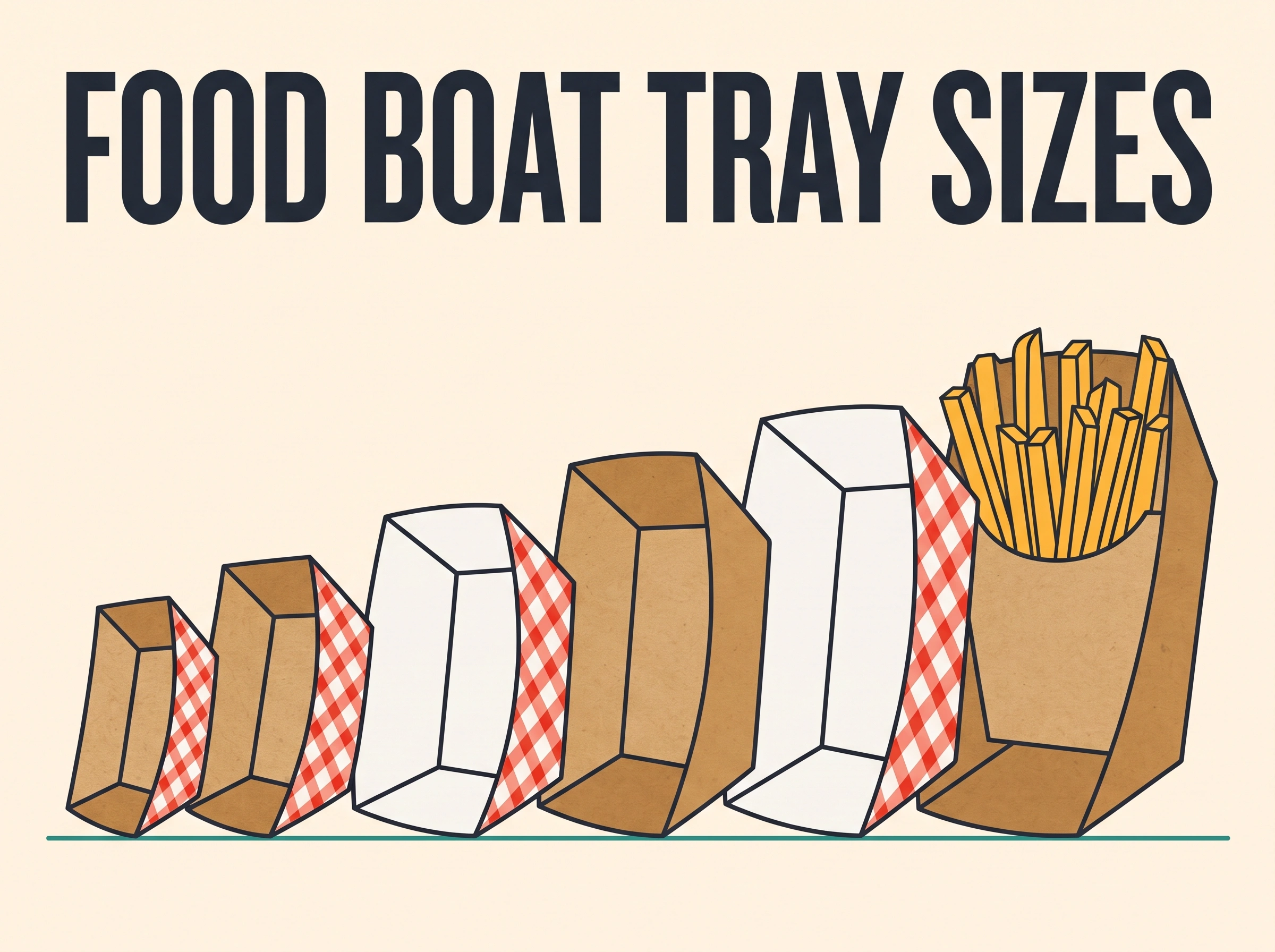
Food boat trays come in numbered sizes that match how much food they hold. A #100 tray holds 1 lb and measures 5.16″ × 3.59″ × 1.48″ (13.1 × 9.1 × 3.77 cm). A #300 tray holds 3 lb at 7.01″ × 4.89″ × 2.13″. A #500 tray holds 5 lb at 8.67″ × 5.48″ × 2.31″. All length and width numbers are measured from the top of the tray, since the sides slope inward toward the base.
Picking the wrong tray size costs you money twice. Order too small, and your fries spill on the counter. Order too big, and you pay for board you never fill.
The good news? Once you learn the numbering system, choosing the right paper food tray takes about ten seconds. This guide gives you every dimension, every capacity, and a simple chart that matches each tray size to the food you serve.
Let’s get into it.
Food Boat Tray Size Chart (Inches & Centimeters)
Here is the full range of standard disposable food tray sizes used across the US foodservice industry.
| Tray # | Capacity | Dimensions (inches, top) | Dimensions (cm) | Best For |
|---|---|---|---|---|
| #25 | 1/4 lb | 4.0 × 3.0 × 1.2 | 10.2 × 7.6 × 3.0 | Sauces, small sides, samples |
| #50 | 1/2 lb | 4.6 × 3.3 × 1.3 | 11.7 × 8.4 × 3.3 | Corn dogs, tater tots, kids’ portions |
| #100 | 1 lb | 5.16 × 3.59 × 1.48 | 13.1 × 9.1 × 3.77 | French fries, sliders, single sides |
| #200 | 2 lb | 5.9 × 4.1 × 1.8 | 15.0 × 10.4 × 4.6 | Chicken tenders, onion rings |
| #250 | 2 1/2 lb | 6.55 × 4.62 × 1.88 | 16.6 × 11.7 × 4.8 | Burgers with a side, tacos |
| #300 | 3 lb | 7.01 × 4.89 × 2.13 | 17.8 × 12.4 × 5.4 | Nachos, funnel cake, combo plates |
| #500 | 5 lb | 8.67 × 5.48 × 2.31 | 22.0 × 13.9 × 5.9 | Loaded fries, poutine, share platters |
Two more shapes sit outside this system:
- Hot dog trays are long and fluted, usually 6″ to 7″ end to end. They hold the bun tight so it does not roll.
- Quarter-sheet trays run about 12.75″ × 8.87″ × 1.25″ and work for full meals or catering lines.
Note for publishing: the #100, #250, #300 and #500 rows are confirmed against current manufacturer specs. Verify the #25, #50 and #200 rows against your own die lines before this page goes live.
What the Numbers Actually Mean
Here is the part almost nobody explains.
The number on a food boat points to its weight capacity in pounds, using a simple rule: the number divided by 100 equals the pounds it holds.
- #100 ÷ 100 = 1 lb
- #250 ÷ 100 = 2.5 lb
- #300 ÷ 100 = 3 lb
- #500 ÷ 100 = 5 lb
The two small sizes follow the same idea in a shorter form. A #25 holds 1/4 lb and a #50 holds 1/2 lb.
One heads-up: a few catalogs list trays as #40 or #700 using their own house numbering. When you cross-shop brands, always compare the inch dimensions, never the number alone. A #300 from one maker can run a little larger or smaller than another.
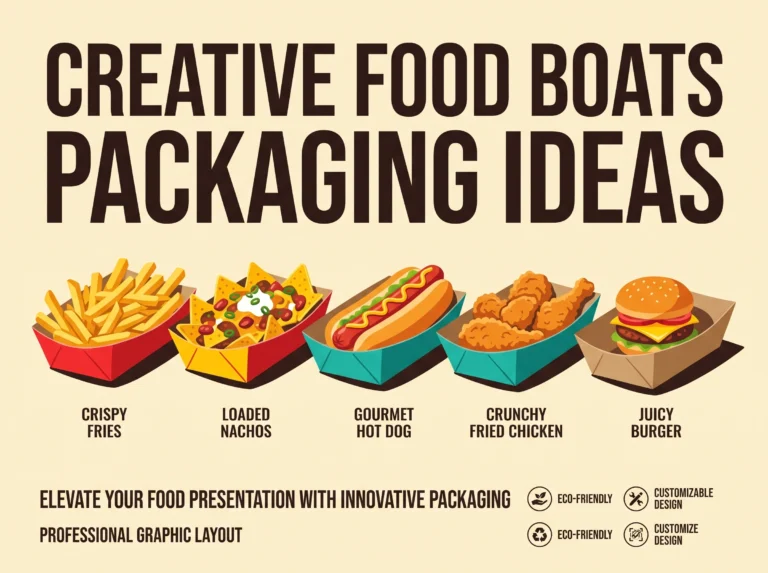
Also Read: Creative Food Boat Packaging Ideas That Make Every Bite Look Better
Top Dimensions vs. Bottom Dimensions
This trips up more buyers than any other detail.
Food boat trays are tapered. The walls slope outward as they rise, so the opening is wider than the base. Manufacturers publish the top length and width, because that is the measurement that matters when you fill the tray.
So if you measure the bottom of a #300 tray with a ruler, you will get a smaller number than the spec sheet shows. Nothing is wrong. You are simply measuring a different part of the tray.
Three measurements to know:
- Top length × top width the opening, and what suppliers list
- Bottom length × bottom width the base footprint, useful for stackable shelf planning
- Depth the wall height, which controls how much food stays put
That taper is also why these trays nest so well. A case of nested trays takes up a fraction of the shelf space that flat containers need, which is a real win inside a food truck cabinet.
Which Size for Which Food?
Weight capacity and volume capacity are not the same thing. Three pounds of nachos fill a tray very differently than three pounds of fries. Use this practical guide instead of doing the math.
| Food Item | Recommended Tray | Why |
|---|---|---|
| French fries (regular) | #100 | Holds a standard basket portion without spilling |
| French fries (large) | #200 or #250 | Extra depth keeps hot fries stacked |
| Nachos with cheese | #300 | Wide opening spreads chips flat for topping |
| Hot dogs | Fluted hot dog tray | Curved base cradles the bun |
| Corn dogs | #50 or #100 | Narrow shape, easy one-hand hold |
| Chicken tenders | #200 | Fits 4–5 tenders with a dip cup |
| Mozzarella sticks | #100 | Compact side portion |
| Onion rings | #200 | Stacks tall without crushing |
| Loaded fries / poutine | #500 | Deep walls hold toppings and sauce |
| Funnel cake | #300 | Wide and flat for powdered sugar |
| Tacos (2–3) | #250 | Keeps shells upright |
| Sliders (2) | #250 | Room for a side |
| Full meal / catering | Quarter-sheet tray | Serves as a plate replacement |
Print this table and tape it inside your prep station. It settles most ordering questions on the spot.
Material Choices That Affect Performance
The board type matters as much as the size.
SBS paperboard (solid bleached sulfate) gives you a bright white surface that prints beautifully. It is the go-to for custom printed branded packaging.
Kraft paperboard delivers that warm brown look buyers now connect with sustainable packaging. It hides light grease marks well, too.
Grease-resistant coating is the feature to ask about. A properly coated tray lets you serve fries and nachos without a paper liner, which cuts your cost per serving and speeds up your line.
On the sustainability side, demand keeps climbing for PFAS-free, compostable and BPI-certified trays. Several US states now restrict PFAS in food-contact packaging, so plastic-free and recyclable options have moved from nice-to-have to standard request. Molded fiber and bagasse trays are growing fast in this space as well.
Case Packs and Storage Math
Case pack counts change by size, which surprises first-time buyers.
| Tray Size | Typical Sleeve Count | Typical Case Pack |
|---|---|---|
| #25 – #200 | 250 per sleeve | 4 sleeves = 1,000 per case |
| #250 – #300 | 250 per sleeve | 2 sleeves = 500 per case |
| #500 | 250 per sleeve | 2 sleeves = 500 per case |
Smaller trays ship 1,000 to a case. Larger ones ship 500. So when you compare prices between two sizes, always check the cost per tray, not the cost per case. That single habit protects your margins.
Also ask your supplier for the case cube and Ti-Hi figures if storage space is tight. A 1,000-count case of #100 trays runs roughly 0.85 cubic feet, which helps you plan shelving before the pallet arrives.
Custom Sizes and Branded Printing
Standard sizes cover most menus. But if you serve something unusual, a custom size food tray solves it.
Custom orders start with a die line a flat template that maps every fold and cut. Your supplier builds it from your measurements, then prints your logo, colors and artwork directly on the board.
Teams at Prefine Packaging typically ask for three things before quoting a custom tray: the finished inside dimensions you need, your board and coating preference, and your target order volume. Having those ready cuts days off your turnaround.
Expect a minimum order quantity on custom work, since a new die has to be cut and set up. Standard stock sizes have far lower minimums, so if a #250 or #300 gets you 90% of the way there, that is usually the smarter first order.
Five Mistakes That Cost Operators Money
- Ordering by number instead of by inches. House numbering varies between brands. Compare dimensions.
- Measuring the base. Spec sheets list top dimensions. Your ruler on the bottom will not match.
- Ignoring depth. Two trays with the same footprint can hold very different amounts. Depth decides.
- Skipping the coating question. Uncoated board plus hot fries equals a soggy tray and an unhappy customer.
- Buying one size for everything. A #300 for a kids’ portion wastes board on every single order. Stock two or three sizes.
Frequently Asked Questions
What size is a #300 food tray?
A #300 tray holds 3 lb and measures about 7.01″ × 4.89″ × 2.13″ (17.8 × 12.4 × 5.4 cm) at the top opening.
What do the numbers on food trays mean?
The number shows weight capacity in pounds. Divide by 100 to get the pounds. A #200 holds 2 lb, a #500 holds 5 lb.
How many ounces does a 1 lb food boat hold?
A #100 tray holds roughly 16 oz by weight. Actual volume depends on the food, since light items like popcorn fill the space faster than dense ones.
What is the difference between a food boat and a food tray?
The terms are used for the same product. “Boat” describes the tapered, open shape with sloped sides. “Tray” is the broader category name.
What size food tray is best for french fries?
A #100 fits a standard portion. Step up to a #200 or #250 for large orders, since the extra depth keeps fries from tipping out.
What size tray works for nachos?
A #300 is the popular pick. The wide opening lets chips lie flat so cheese and toppings spread evenly.
Are food boat dimensions measured at the top or bottom?
At the top. The sides slope inward, so the base is always smaller than the listed size.
What is the standard hot dog tray size?
Most fluted hot dog trays run 6″ to 7″ long, shaped to hold a bun securely.
Are paper food trays grease-proof?
Coated trays are grease- and moisture-resistant, so you can serve fried food without a separate liner. Uncoated kraft trays need a liner for oily items.
Are food boats recyclable or compostable?
Many are both. Look for compostable certification and PFAS-free labeling if sustainability is a requirement for your venue.
Can food trays be made in a custom size?
Yes. A custom die line lets you set exact inside dimensions, board type and printed design.
How many food trays come in a case?
Usually 1,000 for smaller sizes and 500 for larger ones, packed in sleeves of 250.
What is the largest standard food boat size?
The #500 at 5 lb is the largest common boat. For bigger servings, operators move to quarter-sheet trays.
Choosing Your Size With Confidence
Here is the short version. Match the tray number to the pounds you serve. Compare inch dimensions across brands rather than trusting the number. Measure from the top, not the base. And pick a grease-resistant board if anything on your menu comes out of a fryer.
Stock two or three sizes rather than one. A #100 for sides, a #300 for mains, and a #500 for share portions covers most concession stand, food truck and quick service restaurant menus with almost no waste.
Got a portion size that does not fit the chart? That is exactly what custom die lines are for.