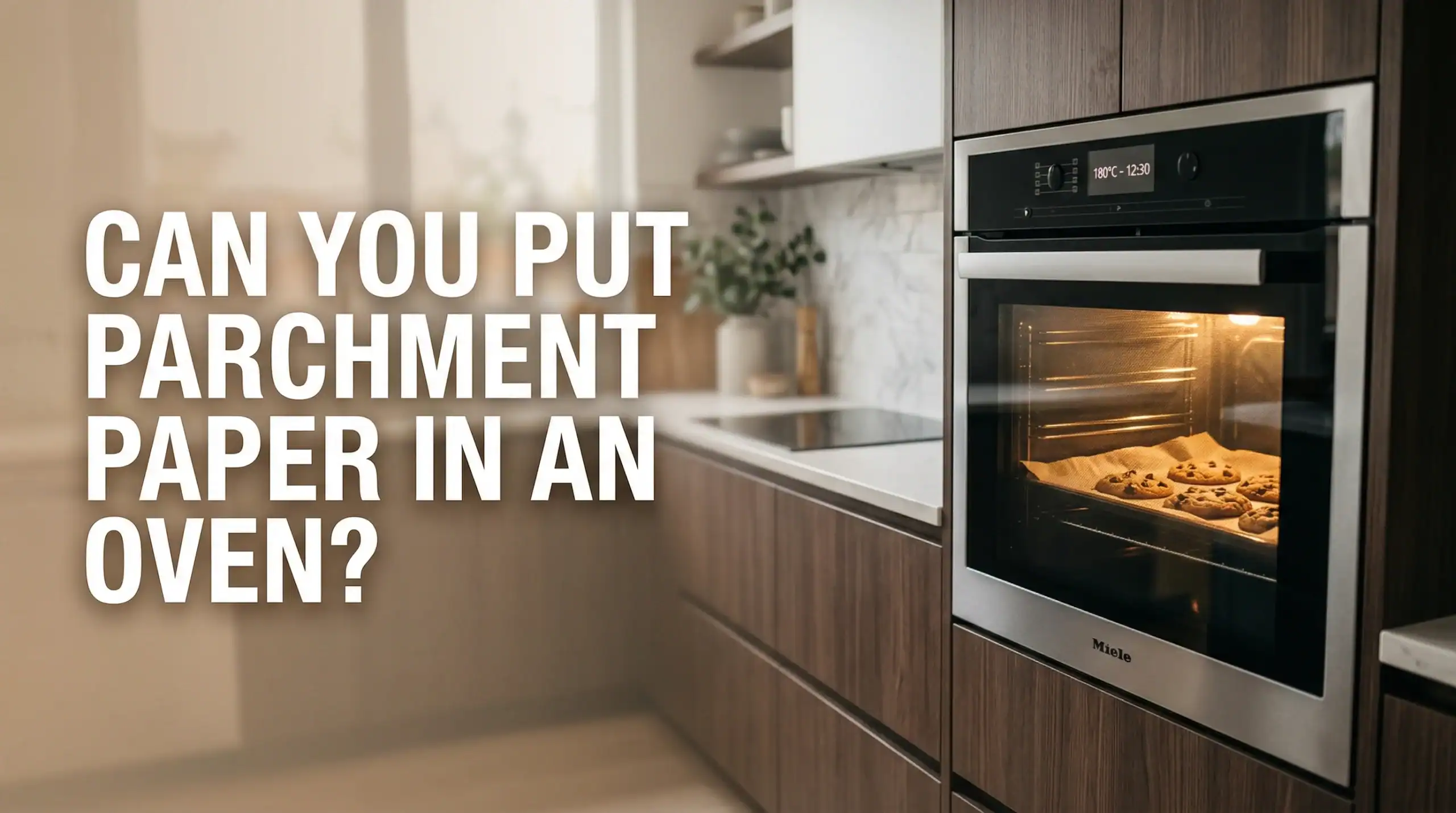
Yes. Parchment paper is oven-safe up to 420°F–450°F (215°C–232°C). It is coated with food-grade silicone, making it heat-resistant and non-stick. Do not use it under a broiler or above 450°F, where it risks charring. It performs safely in convection ovens, toaster ovens, and air fryers when food holds it flat against the pan.
Key Takeaways
- Parchment paper is oven-safe up to 450°F / 230°C
- Coated with food-grade silicone not wax delivering proven heat resistance
- Never use under a broiler broilers exceed 500°F, far past the safe limit
- Wax paper is NOT oven-safe it melts, smokes, and can contaminate food
- Unbleached parchment paper is the PFAS-free, chlorine-free, non-toxic choice
- Works safely in air fryers, convection ovens, toaster ovens, and microwaves
- Silicone baking mats like Silpat are the best reusable long-term alternative
- Quality sourcing matters food-grade baking parchment from verified suppliers like Prefine Packaging ensures consistent silicone coating standards and heat performance
What Is Parchment Paper Made Of?
Parchment paper also sold as baking paper or baking parchment is a cellulose-based paper processed through an acid-bath treatment and then finished with a thin, even coat of food-grade silicone. That silicone-coated paper surface is what gives it two non-negotiable baking properties: reliable heat resistance and a naturally non-stick baking liner finish that works without greasing, spraying, or buttering the surface.
This composition is exactly what separates parchment paper from wax paper. Wax paper is coated with paraffin wax a petroleum-derived substance that melts at low oven temperatures, produces visible smoke, and can transfer chemical residue directly onto food. The parchment vs wax paper heat distinction is one of the most consequential safety differences a home baker needs to understand before lining a single pan.
Bleached vs. Unbleached Parchment Paper
Two distinct varieties sit side by side on most store shelves.
Bleached parchment paper is white and uses chlorine compounds during the pulp-whitening process. It is widely available, performs well as an oven-safe paper, and meets FDA food-safety standards for direct food contact.
Unbleached parchment paper is brown, skips chlorine processing entirely, and has become the preferred non-toxic baking material for health-focused and environmentally aware households. It produces no chlorine byproducts, is more commonly available in compostable certified versions, and delivers identical baking paper heat resistance in every oven application.
Well-known brands in this space include Reynolds Kitchens for mainstream availability and If You Care for certified eco-friendly parchment paper. For bulk, food-service, and commercial baking operations, sourcing food-safe baking parchment from verified packaging manufacturers ensures consistent silicone coating standards, controlled thickness, and confirmed FDA-compliant materials qualities that directly affect real-world heat resistance and non-stick baking liner performance in high-volume kitchen environments.
Exact Temperature Limits by Oven Type
| Oven / Appliance Type | Max Safe Temp for Parchment | Key Safety Note |
|---|---|---|
| Standard Oven | 450°F / 232°C | Safe for roasting, baking, and cookie sheets |
| Convection Oven | 450°F / 232°C | Weight paper with food the fan can lift loose sheets |
| Toaster Oven | 425°F / 218°C | Keep at least 1 inch from all exposed heating coils |
| Air Fryer | 400°F / 204°C | Use perforated liners only: food must hold paper flat before starting |
| Microwave | No dry heat limit | Safe for covering, wrapping, and steam cooking |
| Broiler | NOT SAFE | Broilers hit 500°F–550°F switch to foil only |
| Dutch Oven (closed lid) | 450°F / 232°C | Paper browns but holds safely during initial covered bake |
| Pizza Stone | 450°F / 232°C | Slide out after 4–5 min finish pizza directly on the stone |
| Open Flame / Grill | NOT SAFE | Direct flame contact fire risk, no exceptions |
What temperature does parchment paper catch fire?
Paper reaches its autoignition point near 451°F (233°C) the same temperature that inspired Ray Bradbury’s novel Fahrenheit 451. At this threshold, paper does not ignite instantly, but sustained exposure causes progressive charring, smoke production, and eventual combustion. Always stay within rated limits.
Parchment Paper Dos and Don’ts
| DO | DON’T |
|---|---|
| Use under 450°F / 232°C at all times | Use under the broiler ever |
| Weight paper flat with food before heating | Pre-heat oven with empty, loose parchment inside |
| Use perforated liners in the air fryer | Substitute wax paper in any hot oven application |
| Choose unbleached parchment for non-toxic baking | Let paper edges overhang near heating elements |
| Reuse 2–3 times if paper is still pale and intact | Use above 450°F in any oven type |
| Use as a lifting sling for Dutch oven bread | Use on open grills or over direct flame |
| Line cake pans, sheet pans, loaf pans, and molds | Confuse grease-proof paper with silicone-coated parchment |
| Trim paper to fit inside pan walls cleanly | Use paper that has already darkened or turned brittle |
| Store flat or rolled to prevent crease-lifting during baking | Stack heavy items on rolled parchment — it crushes the coating |
Parchment Paper vs. Wax Paper vs. Foil vs. Silicone Mat
The difference between wax paper and parchment paper in the oven is a safety issue, not a stylistic preference. Here is the definitive, fully scored comparison table every baker should bookmark.
| Feature | Parchment Paper | Wax Paper | Aluminum Foil | Silicone Mat (Silpat) |
|---|---|---|---|---|
| Oven-Safe? | Up to 450°F | Melts & smokes | All temperatures | Up to 480°F |
| Broiler-Safe? | No | No | Yes | No |
| Non-Stick Quality | Excellent | Cold use only | Needs greasing | Excellent |
| Air Fryer Safe? | With food on top | No | Model-dependent | Some models only |
| Reusable? | 2–3 light uses | Single use only | Sometimes | 1,000+ uses |
| PFAS-Free Options? | Unbleached versions | Paraffin coating | Uncoated foil only | Widely available |
| Compostable? | Certified versions exist | No | No | No |
| Microwave-Safe? | Yes | Yes | No | Yes |
| Freezer Use? | Excellent | Good | Can stick | Good |
| Cost Per Use | Low | Very Low | Low | Very Low (long-term) |
| Eco-Friendly? | Compostable versions | Low | Recyclable | Best long-term |
| Best Application | Baking, roasting, steaming | Cold wrapping only | High-heat, broiling | Frequent cookie baking |
| Overall Score | 9 / 10 | 3 / 10 (oven) | 7 / 10 | 9.5 / 10 |
Can you use parchment paper instead of foil in the oven?
For all oven temperatures under 450°F, yes parchment paper outperforms aluminum foil on non-stick release and food quality. For broiling, high-heat roasting above 450°F, or tightly sealing food for steam cooking, aluminum foil is the correct and safer choice.
Parchment paper vs silicone mat for baking:
The Silpat silicone baking mat wins on reusability, long-term cost efficiency, and environmental impact. However, custom parchment paper remains the more versatile daily choice for lining irregular pans, springform molds, loaf tins, and shaped baking dishes where a flat rigid mat cannot conform to the shape.
How to Use Parchment Paper Correctly Step by Step
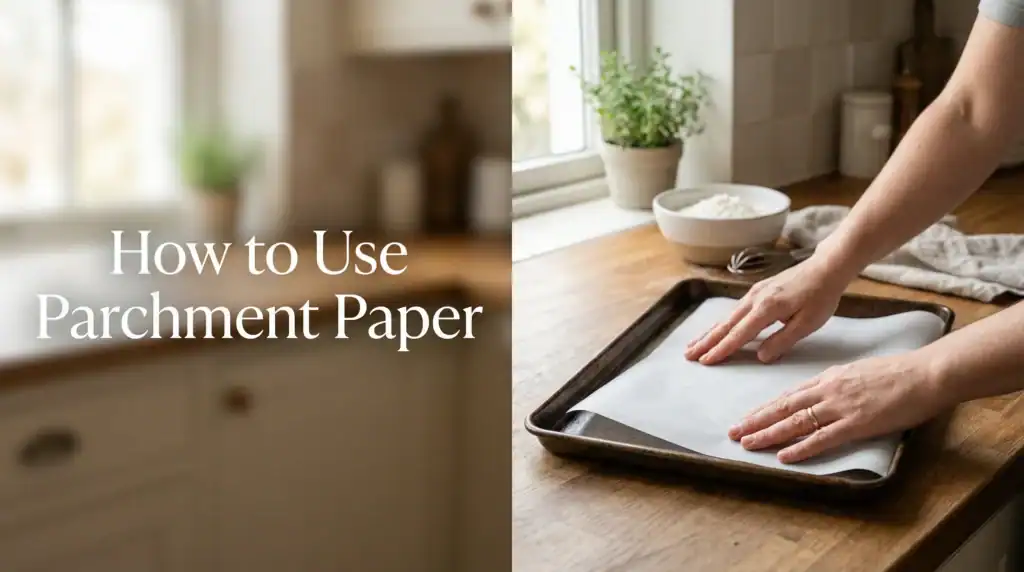
Drawing from hands-on baking experience across breads, pastries, roasted proteins, and sheet-pan meals, here is the method that eliminates every common parchment mistake.
Step 1 Cut to fit, not to hang.
Trim your baking sheet liner so it sits flat inside the pan with no overhang past the rim. Hanging paper edges curl upward toward oven walls and heating elements during baking a fire risk at temperatures approaching the 450°F limit.
Step 2 Skip the grease on the liner.
The food-grade silicone coating on quality parchment paper eliminates the need for butter, spray oil, or flour on the liner surface itself. Lightly greasing the pan beneath the paper helps anchor the sheet and prevents sliding when loading.
Step 3 Anchor before the oven.
In a convection oven, the internal fan creates air movement that can shift a loose baking parchment sheet before food is placed. Press the paper firmly into pan corners, or crease it over the pan edges to hold it in place during loading.
Step 4 Reuse with clear judgment. Can you reuse parchment paper in the oven?
Yes 2 to 3 times for dry items like cookies, biscuits, or pastry. Retire the sheet when it darkens beyond pale golden, becomes brittle at the edges, or has absorbed significant fat from roasted meats or buttery pastries. When in doubt, replace it.
Step 5 Store flat or rolled, never folded.
Creased parchment paper lifts at fold lines during baking, creating raised edges that can catch heat unevenly or touch oven walls. Store sheets flat in a drawer or keep the roll in its original dispenser box.
Can You Use Parchment Paper Under the Broiler?
No and this answer has no exceptions.
Broilers operate at 500°F–550°F (260°C–288°C) a temperature range that sits significantly above the 450°F / 232°C maximum safe threshold for parchment paper heat resistance. Under direct, intense radiant heat from overhead broiler elements, baking parchment will char rapidly, produce smoke, and can ignite especially at dry, exposed edges not covered by food.
The correct approach: If a recipe requires finishing under the broiler after an initial oven bake on parchment, remove the parchment entirely before switching to broil mode. Transfer the food to a foil-lined broiler pan or bare oven rack. Aluminum foil is the only paper-style liner rated safe at broiler temperatures.
Air Fryer, Toaster Oven, Convection Oven, and Microwave Safety
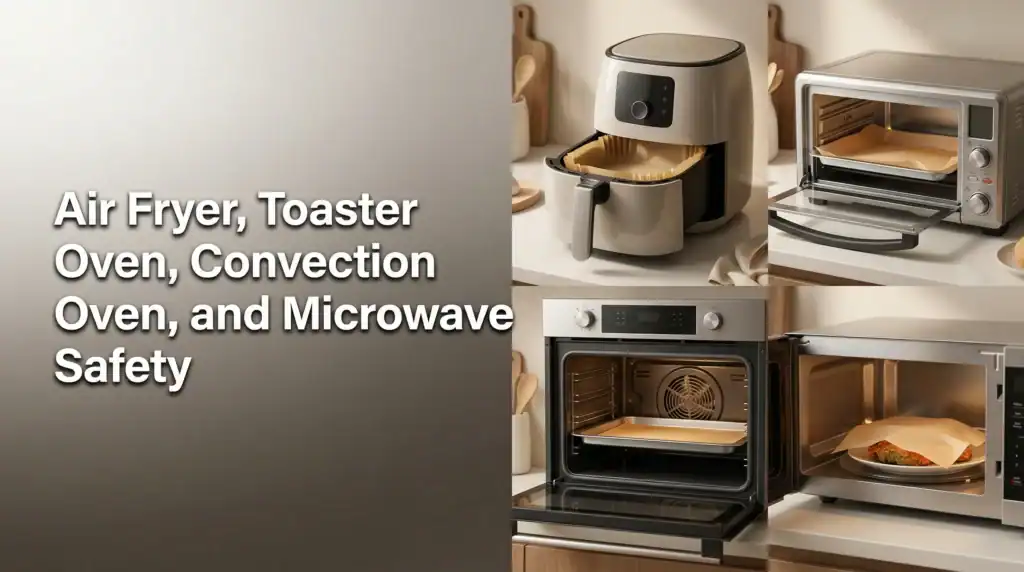
Air Fryer Parchment Paper
Air fryer parchment paper ranks among the fastest-growing kitchen search categories in 2025–2026. Pre-cut perforated parchment liners designed specifically for air fryer baskets allow the hot circulating air that produces crispy results to flow through the paper freely.
The one rule that cannot be skipped: Never place empty parchment in a preheating air fryer. Without food anchoring it flat, the fan draws the lightweight cooking paper directly upward into the heating element a fire hazard. Always load food onto the liner first, then start the appliance.
Toaster Oven Parchment Safety
Parchment paper in a toaster oven is safe at temperatures up to 425°F (218°C) with one non-negotiable condition: maintain a minimum of one inch of clearance between all paper edges and the exposed heating coils. Toaster ovens generate concentrated, localized heat near the coils that can exceed the paper’s rated tolerance even when the thermostat reads a safe temperature.
Convection Oven Safety
Is parchment paper safe to use in a convection oven? Fully safe up to 450°F / 232°C with one practical adjustment. The internal circulation fan can lift lightweight sheets before they are anchored by food. Always place food on the parchment before activating the convection setting, and ensure no paper edges extend past the pan rim where the airflow is strongest.
Parchment Paper in the Microwave
Parchment paper microwave use carries no temperature risk. Microwaves heat food through electromagnetic energy rather than dry radiant heat, so the paper’s heat resistance threshold is never approached. Use it to cover dishes, wrap fish or vegetables for steam cooking, or line microwave-safe plates to simplify clean-up. It is one of the most practical everyday food-safe paper applications beyond traditional oven baking.
Trending Uses: Sourdough, Dutch Oven, Pizza Stone, and Freezer
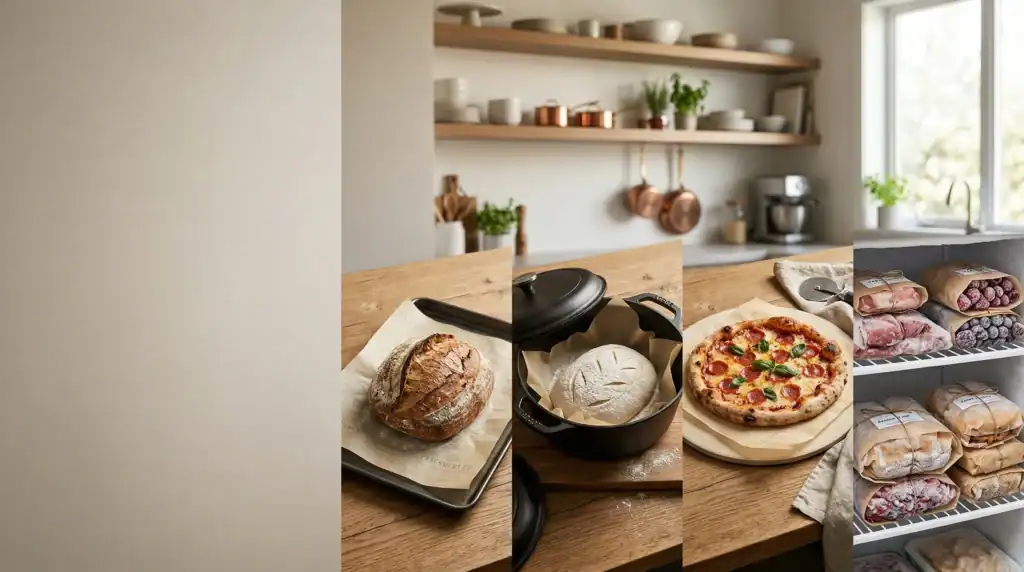
Dutch Oven Bread Baking Parchment Method
The Dutch oven bread baking parchment sling technique has become the standard method for home sourdough bakers worldwide. Score your shaped loaf directly on a cut sheet of parchment on the countertop, then use the paper as a lifting sling to lower the dough safely and precisely into a preheated Dutch oven at 450°F protecting hands from severe burns while keeping the delicate scoring intact.
The paper will brown and darken during the initial covered bake this is normal, expected, and harmless. Steam trapped under the closed lid prevents the paper from reaching ignition temperature. After 20–25 minutes, remove the lid (and the darkened parchment if preferred) to finish the crust open-faced for maximum caramelization. The sourdough bread baking parchment method has effectively replaced the need for a traditional floured banneton-to-Dutch-oven transfer, eliminating one of home baking’s most anxiety-producing steps.
Parchment Paper on a Pizza Stone
For parchment paper pizza stone use, build your pizza on a sheet of parchment on a peel, then slide both parchment and pizza onto the preheated stone simultaneously. After 4–5 minutes once the crust has stiffened enough to hold its shape use long-handled tongs to pull the parchment sheet out from underneath. Allow the pizza to complete its bake time in direct contact with the pizza stone for the crispy, blistered base that stone baking is prized for. This method solves the classic problem of raw dough sticking to the stone during transfer without sacrificing crust quality.
Parchment Paper Freezer Use
Parchment paper freezer use is among the most underutilized kitchen techniques. Layer sheets between raw cookie dough rounds, unbaked pastry shells, burger patties, or sliced banana bread before stacking in the freezer. The non-stick baking liner surface releases cleanly from frozen items without tearing, unlike plastic wrap which bonds to wet dough surfaces. It is also odor-neutral, moisture-resistant, and food-safe at freezer temperatures making it a reliable all-purpose kitchen liner from freezer to oven in a single workflow.
Cookie Sheet Liner Getting the Best Results
As a cookie sheet liner trending staple, parchment paper consistently outperforms bare metal pans for baked goods. It produces more even browning by creating a slight insulating barrier against direct pan heat, prevents cookies from spreading excessively into the pan’s surface texture, and eliminates the need for pan washing between batches. For high-volume home bakers, rotating two sheet pans with fresh baking parchment between batches is a professional technique worth adopting.
Eco-Friendly, PFAS-Free, and Compostable Options
Consumer demand for PFAS-free baking liner products has grown sharply as awareness of per- and polyfluoroalkyl substances synthetic chemicals used in some non-stick coatings has reached mainstream grocery shoppers. Selecting specifically labeled PFAS-free and compostable baking paper addresses both personal health concerns and broader environmental responsibility at once.
Unbleached parchment paper from brands like If You Care delivers chlorine-free processing, sustainably sourced wood pulp certification, and verified compostable status meaning it can be added to a home compost bin after use rather than going to landfill. Performance in all oven applications under 450°F is identical to conventional bleached options.
For commercial kitchens, catering operations, and food-service businesses evaluating non-toxic baking materials at scale, working with verified food-grade paper suppliers ensures that silicone coating consistency, material sourcing standards, and FDA compliance hold across every roll factors that matter considerably more at volume than they do for casual home use.
For individual home bakers building a genuinely low-waste kitchen setup, the most practical and responsible system combines compostable baking paper for single-use pan lining with a silicone baking mat for repeated cookie and pastry baking delivering the full versatility of parchment where it is needed while eliminating waste where it is not.
People Also Ask
Can parchment paper go in the oven at 400 degrees?
Yes. 400°F / 204°C sits comfortably within the safe range for all major parchment paper brands. Standard baking parchment handles up to 425°F–450°F without burning, charring, or releasing harmful compounds into food. It is one of the most common and safe baking temperatures for cookies, sheet cakes, and roasted vegetables.
Can parchment paper go in the oven at 425 degrees?
Yes. 425°F / 218°C remains within the rated temperature limit for most parchment paper products. Check your specific brand’s packaging for confirmation Reynolds Kitchens rates their standard parchment to 425°F, while several other brands extend to 450°F. At 425°F, the paper may show slight browning at unprotected edges but will not char or smoke under normal baking conditions.
Is parchment paper the same as baking paper?
Yes parchment paper and baking paper are identical products. Both terms refer to silicone-coated, heat-resistant, non-stick baking liner paper processed from cellulose pulp. The naming difference is regional: baking paper is the standard term in the UK, Australia, and New Zealand, while parchment paper is used in the United States and Canada.
Can you put parchment paper in the oven without a pan?
Not recommended. Without a solid pan underneath, parchment paper has no structural support it sags under the weight of food, folds toward heating elements, and can shift dangerously. Always use parchment paper on top of a baking sheet, sheet pan, baking dish, or within a structured pan. The one exception is the Dutch oven bread method, where the paper sits inside the enclosed pot with the food holding it in place.
Does parchment paper affect baking time?
Minimally, but measurably. Parchment paper creates a slight insulating barrier between the pan surface and the food, which can reduce direct bottom heat transfer. This produces softer cookie bases and more evenly browned cake bottoms desirable in most baking scenarios. For maximum bottom crispness on cookies or flatbreads, a bare, preheated metal pan without parchment delivers the most direct heat contact.
Can wax paper go in the oven instead of parchment paper?
Never. Wax paper is coated with paraffin wax a petroleum-based substance that melts at standard oven temperatures, produces chemical-laced smoke, and can deposit residue directly onto food surfaces. The difference between wax paper and parchment paper in the oven is a fundamental safety distinction. There is no oven temperature at which wax paper becomes a safe substitute for baking parchment.
How many times can you reuse parchment paper?
For dry baking applications cookies, pastries, scones, dry roasted vegetables parchment paper can typically be reused 2–3 times before performance degrades. Retire the sheet when it has darkened to deep brown, become brittle or fragile at the edges, or absorbed significant fat from roasted meats or heavily buttered goods. For wet batters, proteins, or fish, treat each sheet as single-use for food safety and hygiene reasons.
Is unbleached parchment paper better than bleached?
For health and environmental reasons, yes. Unbleached parchment paper avoids chlorine-based whitening processes, produces no dioxin byproducts during manufacturing, and is far more commonly available in certified compostable and PFAS-free versions. Baking performance heat resistance, non-stick release, and structural integrity is identical to bleached versions at all standard oven temperatures.
Expert Verdict
Parchment paper is among the most reliable, scientifically sound, and broadly practical tools available to any home baker or professional kitchen. Used correctly consistently under 450°F / 232°C, weighted flat by food, kept clear of broilers, open flame, and exposed heating coils it delivers safe, predictable, non-stick results across cookies, artisan bread, roasted proteins, pastry shells, and sheet-pan meals.
The expanding availability of unbleached, PFAS-free, and certified compostable baking paper options means bakers no longer face a trade-off between high performance and environmental responsibility. Sourcing food-grade baking parchment from manufacturers that verify silicone coating consistency and FDA-compliant materials whether for home use or commercial scale is the foundation of safe, trustworthy kitchen practice.
Pair quality parchment paper with a silicone baking mat for your highest-frequency baking tasks, apply the Dutch oven bread parchment sling method for sourdough, and use perforated air fryer parchment liners for crispy air-fried results and you have a complete, optimized, and responsible baking setup built on one of the kitchen’s most proven materials.