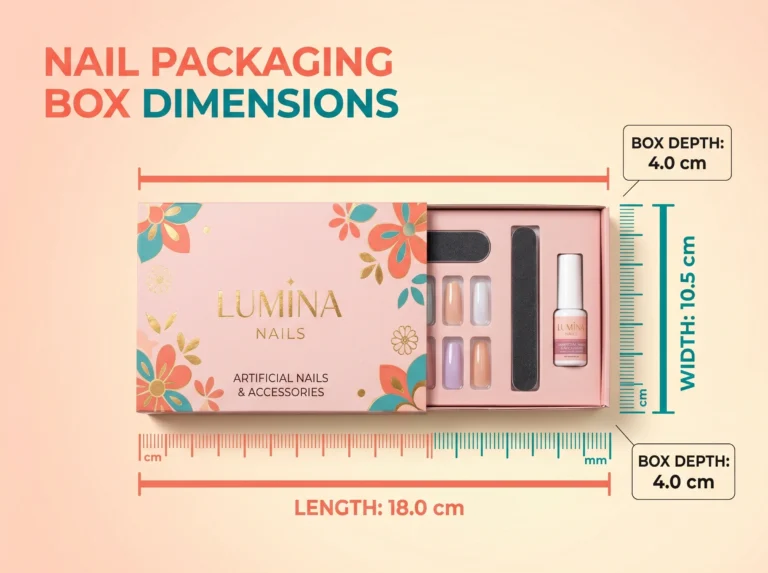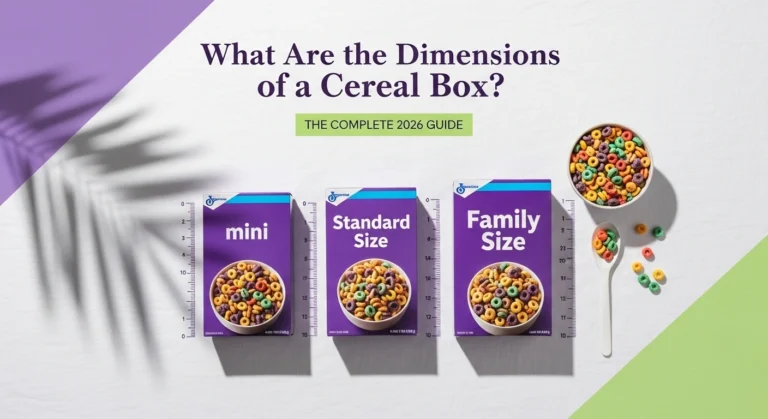
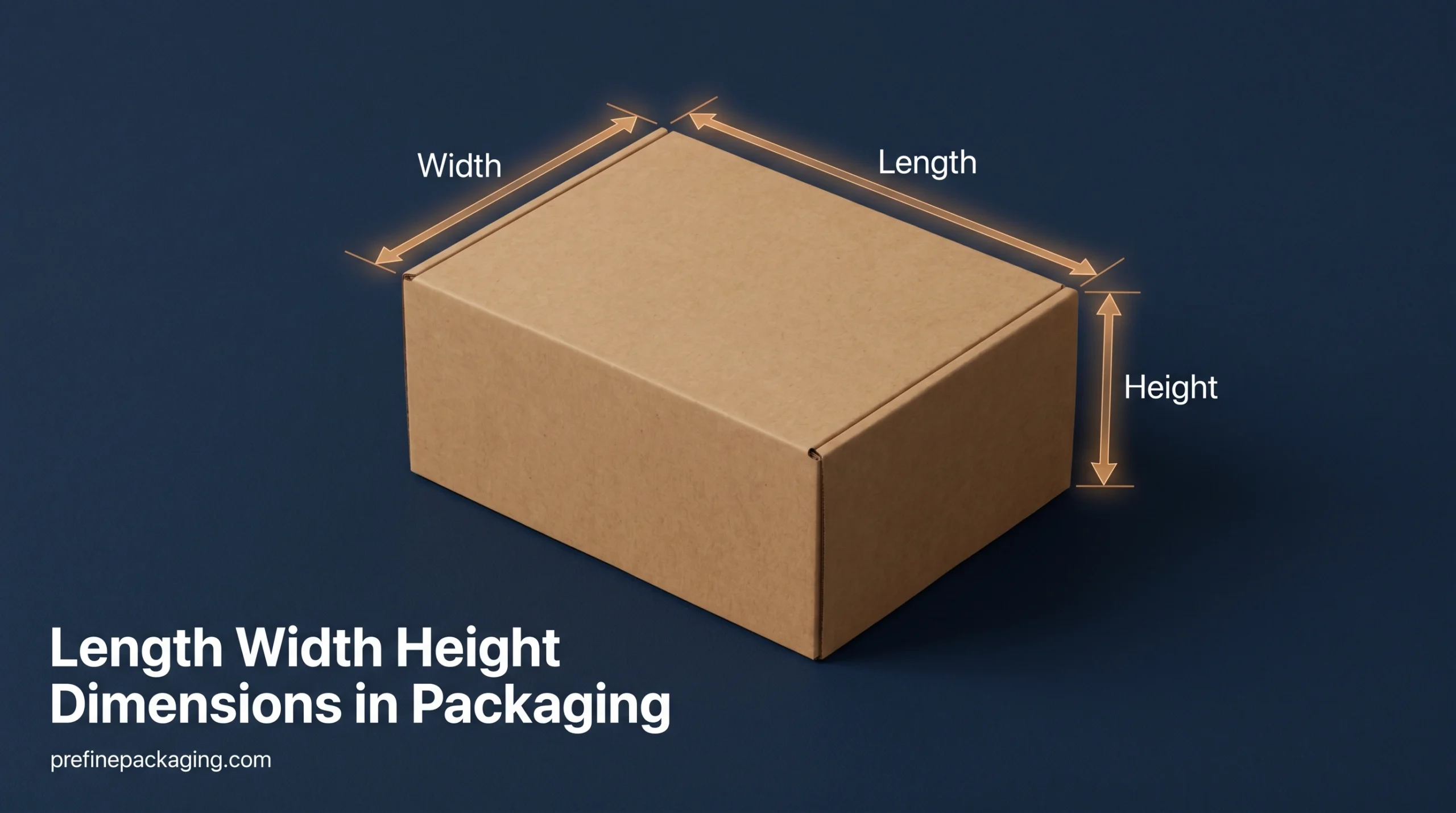
Imagine this: You spend weeks perfecting your product. The branding looks stunning. Customers are excited. Then the first batch of orders arrives and half the products are damaged, crushed, or swimming inside oversized boxes. Sales slow down. Returns pile up. Reviews drop.
The culprit? Incorrect packaging dimensions.
Getting your box dimensions right is one of the smartest, most cost-effective decisions you can make as a business owner. Whether you’re shipping a delicate cosmetic set, a pair of sneakers, or a 5-pound industrial part, understanding length, width, and height and how they work together can be the difference between a smooth operation and an expensive headache.
That’s exactly why trusted custom packaging experts like Prefine Packaging a leading New York-based custom box manufacturer make precise packaging dimensions the very first step in their design and production process. Before a single box goes to print, every L × W × H measurement is confirmed to guarantee a perfect fit for your product.
In this comprehensive box sizing guide, you’ll learn exactly how to measure L × W × H, why the order matters, how packaging size directly impacts your shipping cost, and the latest sustainable packaging dimensions trends shaping 2026.
Let’s get started.
What Are Length, Width, and Height in Packaging?
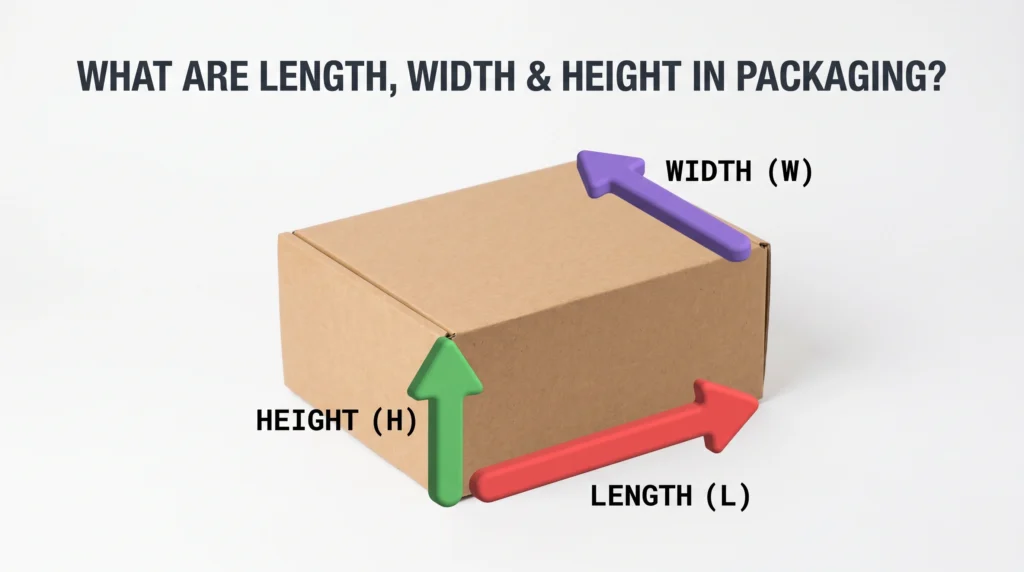
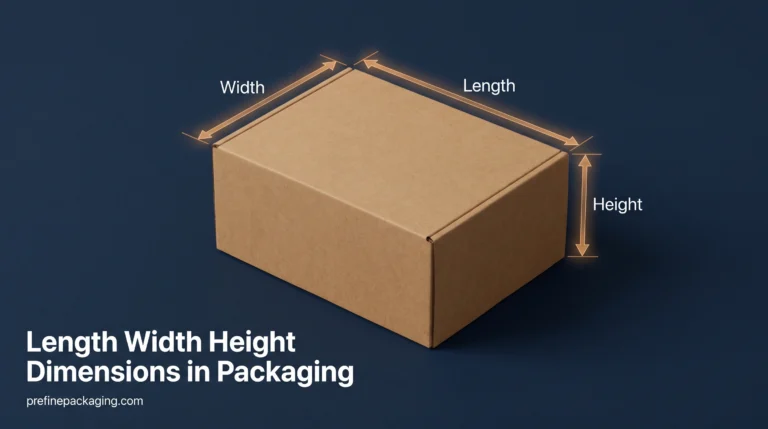
At its core, a packaging dimension is a measurement that describes the physical space a box occupies. Every 3D measurement of a box has three components:
- Length (L) The longest horizontal side of the box, measured from left to right when the box is in its normal upright position.
- Width (W) The shorter horizontal side, measured front to back, perpendicular to the length.
- Height (H) The vertical measurement from the base of the box to the very top.
Together, these three values form the universal LxWxH notation the global standard used across e-commerce packaging standards, logistics, retail, and manufacturing worldwide.
Quick Formula: Box Volume = Length × Width × Height
Example: A shipping box measuring 16 × 12 × 8 inches = 1,536 cubic inches of volume.
Simple enough, right? But here’s where many businesses stumble: the order of these measurements matters enormously and so does whether you’re measuring the inside box measurement or the outside box measurement.
When you work with a specialist like Prefine Packaging, their team walks you through exactly which dimensions to provide for each custom box style whether you’re ordering custom corrugated boxes, custom rigid boxes, custom mailer boxes, or specialty formats like custom tuck boxes or custom gable boxes. That level of guided expertise eliminates the most common and costly measurement mistakes before they happen.
Internal Dimensions vs. External Dimensions: Know the Difference
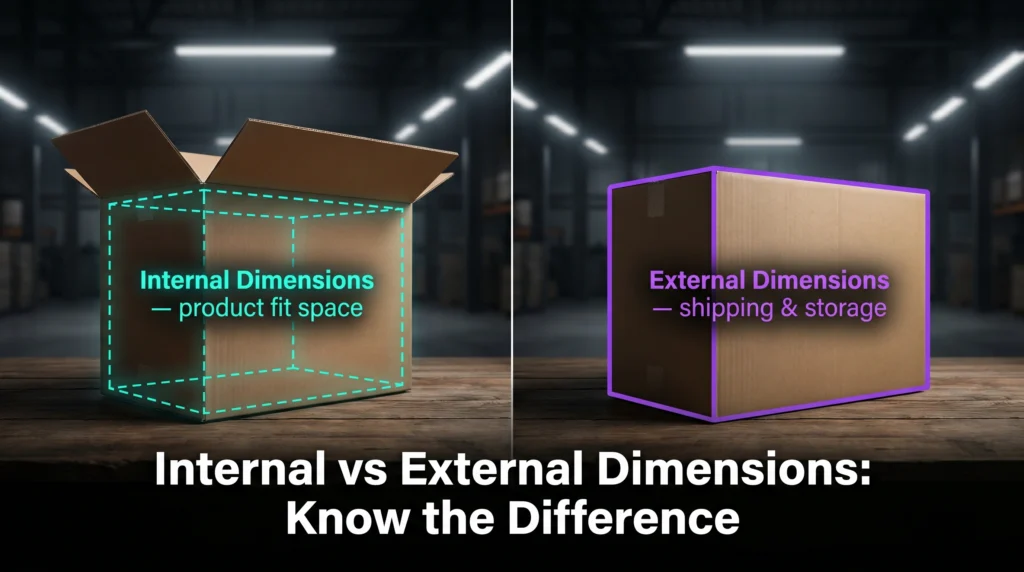
One of the most critical and most commonly overlooked distinctions in custom packaging dimensions is the difference between internal dimensions and external dimensions.
Internal Dimensions (Inside Box Measurement)
Internal dimensions refer to the usable space inside the box. This is what truly matters when you’re fitting a product. If your product is 10 inches long, your box’s inside box measurement must be at least 10 inches plus a little extra for padding and cushioning, void fill material, or product inserts.
Internal dimensions directly affect:
- Product protection packaging Does your item have enough clearance?
- Product clearance inside box Is there room for protective materials?
- Headspace packaging How much air space sits above your product?
External Dimensions (Outside Box Measurement)
External dimensions represent the total outer size of the box, including the material thickness. For corrugated boxes, the kraft flute thickness can add anywhere from 3mm to over 10mm per side a meaningful difference when you’re calculating pallet cube optimization, warehouse bin dimensions, or retail shelf dimensions.
External dimensions matter most for:
- Shipping cost calculation Carriers use external measurements for volumetric weight
- Stacking weight packaging How much weight a stack of boxes can handle
- Pick-and-pack box sizing Ensuring boxes fit efficiently in fulfilment systems
Internal vs External: Side-by-Side Comparison
| Factor | Internal Dimensions | External Dimensions |
|---|---|---|
| Purpose | Product fit & clearance | Shipping & storage planning |
| Used by | Packaging designers, brands | Carriers, warehouse managers |
| Affected by | Product size + cushioning | Material thickness (flute/wall) |
| Measurement tool | Measuring tape inside box | Measuring tape outside box |
| Key concern | Snug fit, void fill, inserts | DIM weight, pallet stacking |
| Industry term | Inside box measurement | Outside box measurement |
Pro Tip: Always design your custom packaging dimensions using internal dimensions for product fit and external dimensions for logistics planning.
The Standard L × W × D Notation: What Order Do Dimensions Go In?
The globally accepted format is Length × Width × Height (or L × W × D notation, where D stands for Depth used interchangeably with height in many industries).
| Dimension | Position | Measurement Direction | Also Called |
|---|---|---|---|
| Length (L) | First | Longest base side, left to right | Longest side |
| Width (W) | Second | Shorter base side, front to back | Breadth |
| Height (H/D) | Third | Vertical, bottom to top | Depth |
This 16×12×8 format and variations like LxWxH notation or L × W × D notation is universally understood by suppliers, carriers, and fulfilment centres. Mixing up this order doesn’t just cause confusion; it can result in incorrect packaging, production errors, wasted materials, and costly re-orders.
Different industries sometimes adjust this order:
- Vertical boxes (like cosmetic tubes or candles): Height may be listed first H × W × L
- Horizontal packaging (like laptop boxes): Length may be exceptionally dominant
- Flat 2D packaging (document mailers, photo envelopes): Only length and width apply no height
How to Measure Box Dimensions Accurately: A Step-by-Step Guide
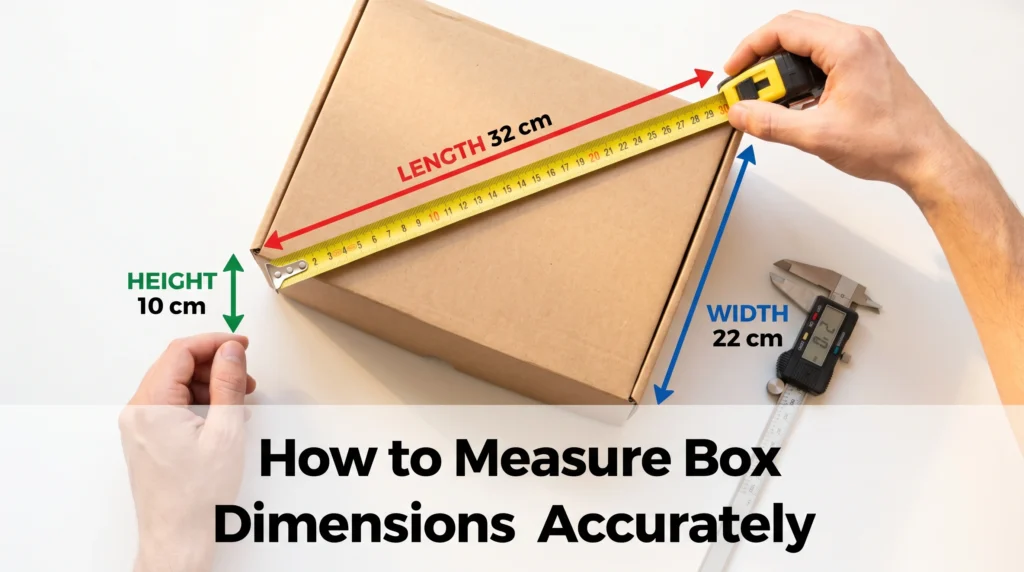
Getting precise carton measurements is easier than you think you just need the right approach. Here’s how to measure a box with confidence:
| Tool | Best For | Accuracy Level |
|---|---|---|
| Measuring tape | Large shipping cartons, corrugated box dimensions | ±1mm |
| Ruler / yardstick | Small mailer boxes, rigid boxes, edge measurements | ±0.5mm |
| Digital caliper | Kraft flute thickness, thin-wall materials | ±0.01mm |
| Smartphone (AR apps) | Quick estimates, irregular shapes | ±3–5mm |
| 3D scanning device | High-volume intake, 3D scanning box measurement | ±0.1mm |
Step 1: Position the Box Correctly
Place your folding carton, tuck-end box, or corrugated box flat on a level surface with the opening facing upward. This is its natural orientation.
Step 2: Measure the Length First
Find the longest side along the base. Lay your measuring tape from one end to the other. This is your Length (L). Record it in your chosen unit inches, centimeters, or millimeters.
Step 3: Measure the Width
Rotate 90 degrees and measure the shorter base side, front to back. This is your Width (W).
Step 4: Measure the Height
Place your measuring tape vertically from the very bottom of the box to the top edge. This is your Height (H) or Depth (D) in some contexts.
Step 5: Calculate Volume
Multiply all three: L × W × H = cubic inches (or cubic centimeters). This cubic dimension formula gives you the box volume essential for shipping cost calculation and space utilization.
No ruler? No problem. A standard US dollar bill is 6.14 × 2.61 inches. A credit card is 3.37 × 2.125 inches. These everyday items can help you estimate dimensions in a pinch.
Once you have your measurements ready, a packaging partner like Prefine Packaging makes the next step effortless simply share your L × W × H specs, choose your box style from their extensive product range, and their team handles everything from free design support through to production and delivery. No back-and-forth confusion, no measurement errors slipping through.
Why Packaging Dimensions Directly Affect Your Shipping Cost
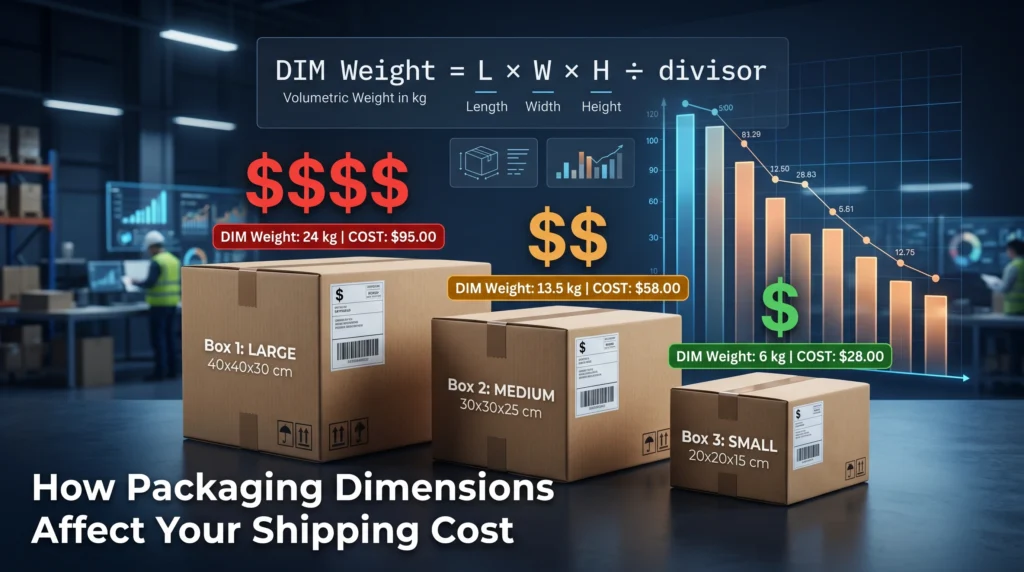
Here’s something every product-based business needs to understand: carriers like UPS, FedEx, and USPS don’t always charge based on how heavy your package is. They use dimensional weight (also called volumetric weight or DIM weight) a pricing method where the space your package occupies is the billing factor.
How UPS Dimensional Weight Works
UPS dimensional weight = (Length × Width × Height) ÷ DIM divisor
If your calculated dimensional weight is greater than your actual package weight, you’ll be charged the higher number. This means a large, lightweight box can cost just as much to ship as a heavy one.
Real-World Impact of DIM Weight Optimization
| Box Size | Actual Weight | Dimensional Weight | You Pay | Savings vs Largest |
|---|---|---|---|---|
| 20 × 20 × 20 in | 2 lbs | 18.5 lbs | 18.5 lbs | — |
| 12 × 10 × 8 in | 2 lbs | 5.5 lbs | 5.5 lbs | ~70% less |
| 10 × 8 × 6 in | 2 lbs | 2.4 lbs | 2.4 lbs | ~87% less |
The smaller, right-sized box wins every time. This is exactly why right-size packaging and fit-to-product packaging have become major priorities in modern logistics.
Smart dimension planning helps you:
- Avoid the oversize box surcharge charged by major carriers
- Reduce packaging waste reduction by eliminating excess material
- Lower your packaging carbon footprint smaller boxes mean fewer trucks on the road
- Improve pallet cube optimization more boxes per pallet = fewer shipments
Standard Packaging Dimensions by Box Type
One of the most searched topics in packaging is “what size box do I need?” This reference table covers the most common standard box sizes used across industries a quick-start guide before you customise.
Common Standard Shipping Box Dimensions (in inches)
| Box Type | Small | Medium | Large | Extra Large |
|---|---|---|---|---|
| Corrugated shipping box | 8×6×4 | 12×10×8 | 16×12×8 | 24×18×12 |
| Mailer box | 6×4×2 | 9×6×4 | 12×9×4 | 14×11×6 |
| Rigid gift box | 5×5×3 | 8×6×4 | 10×8×5 | 14×10×6 |
| Tuck-end box | 3×2×1 | 5×3×2 | 7×5×3 | 10×7×4 |
| Gable box | 4×3×5 | 6×4×7 | 8×5×9 | 10×7×12 |
| Pillow box | 4×2×1 | 6×3×2 | 8×4×2 | 10×5×3 |
| Flat mailer (2D) | 6×4 | 9×6 | 12×9 | 15×12 |
Note: These are common industry reference sizes. Custom packaging dimensions from a specialist like Prefine Packaging can be tailored to your exact L × W × H requirements no standard size required.
Standard Carrier Size Limits (External Dimensions)
| Carrier | Max Length | Max Girth | Max L+2W+2H | Oversize Fee Trigger |
|---|---|---|---|---|
| UPS | 108 in | 165 in | 165 in | Over 130 in combined |
| FedEx | 119 in | 165 in | 165 in | Over 130 in combined |
| USPS Priority | 108 in | 130 in | 130 in | Over 84 in combined |
| DHL Express | 120 in | — | 196 in | Varies by zone |
Knowing these limits before finalising your package size saves you from unexpected oversize box surcharges at checkout.
2D vs 3D Packaging Dimensions: Which Does Your Product Need?
Not all packaging is a box. Understanding packaging aspect ratio and the difference between 2D vs 3D packaging dimensions helps you choose the right structure for every product.
| Feature | 2D Packaging | 3D Packaging |
|---|---|---|
| Dimensions used | Length + Width only | Length + Width + Height |
| Volume | None (flat) | Has internal volume |
| Best for | Documents, photos, flat art | Physical products |
| Examples | Envelopes, flat mailers | Boxes, cartons, tubes |
| Shipping method | Letter/flat rate | Parcel/DIM weight |
| Measurement formula | L × W | L × W × H |
Two-Dimensional Packaging (Flat)
2D packaging has only length and width no height, no volume. Common examples:
- Document mailers
- Photo envelopes
- Flat artwork packaging
- Certificate holders
Three-Dimensional Packaging (Volumetric)
3D boxes have all three dimensions length, width, and height meaning they occupy volume and can hold physical items. This includes:
- Corrugated shipping cartons
- Mailer boxes
- Rigid boxes (luxury packaging)
- Gable boxes and pillow boxes
- Shoe boxes and cereal boxes
Custom Packaging Dimensions: Getting the Perfect Fit for Your Product
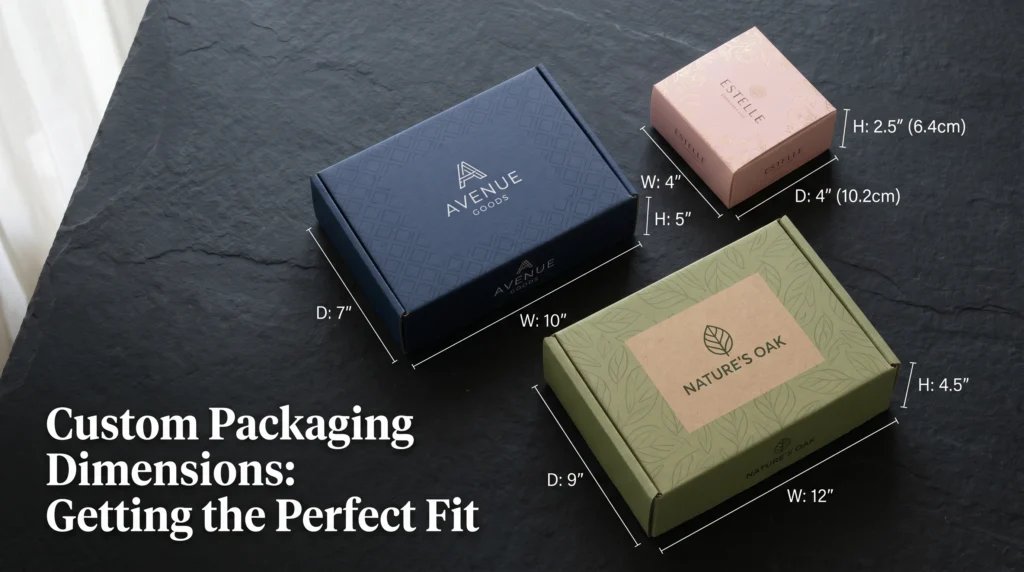
For brands ordering custom box sizes, precision is everything. Whether you’re working with a folding carton, tuck-end box, or a fully custom packaging dimensions solution, here’s what to keep in mind:
| Product Category | Recommended Clearance (per side) | Recommended Void Fill |
|---|---|---|
| Fragile / glassware | 2–3 inches | Foam inserts, bubble wrap |
| Electronics | 1.5–2 inches | Anti-static foam, air pillows |
| Cosmetics / bottles | 0.75–1.5 inches | Tissue paper, cardboard inserts |
| Apparel / soft goods | 0.5–1 inch | Tissue paper, poly bags |
| Food products | 0.5–1 inch | Food-safe paper, sealed liners |
| Books / flat items | 0.25–0.5 inches | Cardboard wrap, corner guards |
| Heavy industrial | 1–2 inches | High-density foam, wooden crating |
1. Measure the Product First Every Single Time
Before you think about the box, measure your product carefully. Use a digital caliper for small or irregular shapes. For unusually shaped items, use 3D scanning box measurement or physical templating with cardboard.
2. Add Clearance for Protection
Don’t design a box that’s an exact match for your product dimensions. Build in:
- Product clearance inside box: Minimum 1–2 inches on all sides for cushioning
- Void fill material allowance: Bubble wrap, foam inserts, tissue paper, or air pillows
- Headspace packaging: Especially important for fragile items that need top padding
3. Account for Material Thickness
Corrugated box dimensions can shrink by 3–10mm per wall once you account for kraft flute thickness. Always request both internal dimensions and external dimensions from your supplier.
4. Think About the Unboxing Experience
Packaging dimensions affect how your product looks and feels when customers open it. A custom box size that’s too large feels wasteful and leaves a poor impression. A perfectly fitted box with intentional headspace packaging and elegant inserts creates a premium unboxing experience customers remember and share on social media.
This is where Prefine Packaging genuinely stands out. Their team specialize in creating custom printed packaging boxes where the box dimensions are engineered around your specific product not the other way around. From custom cosmetic boxes to custom shipping boxes, custom soap boxes, custom CBD boxes, and even custom kraft boxes, every style is built to your exact L × W × H specifications with exceptional print quality and eco-friendly packaging materials. Brands in cosmetics, food, apparel, electronics, and health have used Prefine Packaging to transform their packaging dimensions from a logistics headache into a powerful brand statement.
5. Align With SKU Packaging Specs
For businesses managing multiple products, align your packaging dimensions with your SKU packaging specs. Standardising sizes across your range simplifies pick-and-pack box sizing, reduces packaging inventory complexity, and improves warehouse bin dimensions planning.
Packaging Dimensions Across Different Industries
| Industry | Top Dimension Priority | Key Box Type | Critical Measurement |
|---|---|---|---|
| E-commerce | DIM weight optimization | Corrugated mailer | External dimensions |
| Cosmetics | Unboxing experience | Rigid / magnetic box | Internal dimensions |
| Food & Beverage | Shelf fit & freshness | Folding carton | Carton L × W × D |
| Pharma | Compliance & safety | Tuck-end box | Internal clearance |
| Electronics | Anti-static protection | Custom corrugated | Internal + clearance |
| Apparel | Brand presentation | Mailer / tissue box | External DIM |
| Industrial / B2B | Stacking & pallet fit | Heavy-duty corrugated | External + stacking weight |
Retail & E-commerce
E-commerce packaging standards demand precise package size for fulfilment automation. Amazon’s frustration-free packaging programme has specific box dimension requirements that affect both acceptance and customer ratings. Smart packaging size calculators powered by AI are now widely used to automate right-sizing across large catalogues.
Food & Beverage
Carton length width depth is critical for retail shelf dimensions planning. A box that’s 2mm too wide can disrupt an entire shelf layout. Headspace packaging also plays a food safety role, as excess air in food packaging can impact freshness.
Cosmetics & Beauty
Luxury brands rely on custom packaging dimensions to create the perfect unboxing experience. Rigid boxes and magnetic boxes with precise internal dimensions ensure products sit exactly as intended creating that premium feel that drives brand loyalty. Prefine Packaging is a particularly strong partner for cosmetics and beauty brands, offering custom cosmetic boxes, custom lip balm boxes, and custom rigid magnetic boxes with fully tailored box dimensions, premium finishes, and free design support all with no minimum order quantity (MOQ) so small brands can order confidently.
Industrial & B2B
Stacking weight packaging and pallet cube optimization are top priorities. Accurate external dimensions allow logistics teams to calculate cubic dimension formulas, optimise warehouse bin dimensions, and plan truck loads efficiently reducing the box tare weight carried as dead freight.
Packaging Dimensions & Material Comparison
Your choice of packaging material directly affects the usable internal dimensions of your box. Here’s how the most common materials compare:
Material Thickness Impact on Box Dimensions
| Material Type | Wall Thickness | Impact on Internal Dimensions | Best For |
|---|---|---|---|
| Single-wall corrugated | ~3mm (B-flute) | Reduces each dimension by ~6mm | Light e-commerce, mailers |
| Single-wall corrugated | ~4mm (C-flute) | Reduces each dimension by ~8mm | Standard retail shipping |
| Double-wall corrugated | ~6–7mm | Reduces each dimension by ~12–14mm | Heavy or fragile products |
| Triple-wall corrugated | ~10–12mm | Reduces each dimension by ~20–24mm | Industrial, very heavy loads |
| Rigid (greyboard) | ~2–3mm | Reduces each dimension by ~4–6mm | Luxury, cosmetics, gifts |
| Kraft paperboard | ~0.5–1mm | Minimal impact | Light retail, folding cartons |
| Plastic corrugated | ~4–6mm | Reduces each dimension by ~8–12mm | Reusable, moisture-sensitive |
Kraft Flute Types & Dimensions Reference
| Flute Type | Flute Height | Flutes per Foot | Best Application |
|---|---|---|---|
| A-flute | 4.8mm | 33 per ft | Fragile, cushioning priority |
| B-flute | 2.4mm | 47 per ft | Canned goods, retail displays |
| C-flute | 3.6mm | 38 per ft | General shipping (most common) |
| E-flute | 1.2mm | 90 per ft | Cosmetics, thin retail boxes |
| F-flute | 0.8mm | 128 per ft | Very fine retail, point-of-sale |
| BC double-wall | 6.0mm | Combined | Heavy-duty shipping |
Understanding these material differences helps you communicate clearly with suppliers like Prefine Packaging and ensure the internal dimensions you design around are truly achievable in the finished box.
Sustainable Packaging Dimensions: The 2026 Trend You Can’t Ignore
The biggest shift in packaging today is the relentless drive toward sustainable packaging dimensions and eco-friendly box sizing. In 2026, brands that optimise their packaging dimensions for sustainability aren’t just doing the right thing they’re gaining a real competitive edge.
Sustainability Impact of Right-Size Packaging
| Packaging Approach | Material Used | CO₂ Impact | Shipping Cost | Customer Perception |
|---|---|---|---|---|
| Oversized box (standard) | High waste | Higher carbon | High DIM charge | Negative / wasteful |
| Right-size packaging | Optimised | Reduced ~25% | Lower DIM | Positive / professional |
| Fit-to-product packaging | Minimal | Reduced ~40% | Lowest DIM | Premium / eco-conscious |
| Zero waste packaging design | Recycled/minimal | Lowest | Lowest DIM | Strongly positive |
Right-Size Packaging Is Now a Business Imperative
Right-size packaging designing boxes to closely match product dimensions directly reduces material usage, lowers DIM weight optimization costs, and shrinks your packaging carbon footprint. Brands that have embraced fit-to-product packaging report material savings of 20–40% per unit.
Zero Waste Packaging Design Is Going Mainstream
The zero waste packaging design movement pushes brands to eliminate unnecessary headspace packaging, reduce void fill material, and transition to recycled corrugated materials. Accurate packaging dimensions are foundational to this you can’t reduce waste without first knowing exactly how much space your product actually needs.
Prefine Packaging is fully aligned with this shift. Their eco-friendly packaging options including custom kraft boxes and recycled corrugated materials are designed to minimise packaging waste while maintaining outstanding print quality and product protection. For brands with sustainability goals, choosing a supplier whose materials and packaging dimensions philosophy both align with zero waste packaging design is a significant advantage.
AI Box Size Recommendation Tools Are Transforming Operations
Smart packaging size calculators and AI box size recommendation platforms are now accessible to businesses of every size. These tools analyse your product dimensions, weight, fragility rating, and carrier pricing to recommend the optimal custom box size automatically. The result: lower shipping cost, less waste, and a better unboxing experience.
3D Scanning Box Measurement Is Rising Fast
High-volume e-commerce brands are adopting 3D scanning box measurement technology to capture precise package dimensions at intake instantly generating L × W × H data and flagging DIM weight optimization opportunities. What once took a warehouse worker 30 seconds per item now happens in under 2 seconds.
Common Packaging Dimension Mistakes and How to Avoid Them
| Common Mistake | The Fix |
|---|---|
| Using external dimensions for product fit | Always design to internal dimensions |
| Ignoring kraft flute thickness | Request both internal + external from supplier |
| Wrong L × W × H order with supplier | Confirm notation format before ordering |
| Not calculating DIM weight before ordering | Run DIM formula on every new SKU |
| Over-packing clearance (excess void fill) | Calculate minimum safe clearance by product type |
| Ordering one size for all products | Create SKU packaging specs per product line |
| Forgetting material thickness in re-orders | Always note material type alongside dimensions |
Even experienced teams make these errors. Here’s the full breakdown:
Confusing Internal Dimensions with External Dimensions
Always clarify which measurement you’re working with. Ordering a box based on external dimensions when you need internal dimensions will result in a product that doesn’t fit.
Forgetting Kraft Flute Thickness
Corrugated box dimensions shrink once you account for wall thickness. A box listed as 12 × 10 × 8 inches externally may have inside box measurements of 11.5 × 9.5 × 7.5 inches a meaningful difference.
Mixing Up the L × W × D Notation Order
Swapping length and width when placing an order with a supplier produces a box that’s rotated 90 degrees your product may sit awkwardly, tilt, or leave unintended gaps. Always confirm the LxWxH notation order with your manufacturer.
Ignoring Dimensional Weight Until the Invoice Arrives
Calculate your volumetric weight before finalising box sizes. Run the UPS dimensional weight or FedEx DIM weight formula on every new SKU to avoid surprise shipping surcharges.
Over-Specifying Clearance and Ignoring Headspace Packaging
More isn’t always better. Excessive product clearance inside box means more void fill material, higher packaging waste, and a higher DIM weight charge. Design for the minimum safe clearance not the maximum.
FAQs
These are the most commonly searched questions about box dimensions and packaging measurements answered clearly.
What comes first length, width, or height in packaging?
Length always comes first in the standard L × W × H format. Length is the longest side, followed by width (shorter base side), then height (vertical). This is the globally accepted packaging dimension order used by suppliers, carriers, and manufacturers.
What is the difference between depth and height in packaging?
Depth and height are often used interchangeably in packaging. Height describes vertical measurement from base to top in upright boxes. Depth is the same measurement but more common in horizontal or shallow packaging like trays and drawer boxes.
How do I calculate the volume of a shipping box?
Use the simple box volume formula: Length × Width × Height = cubic inches (or cubic centimeters). For example, a box measuring 12 × 10 × 8 inches = 960 cubic inches of volume.
What is dimensional weight and how does it affect my shipping cost?
Dimensional weight (or DIM weight) is a carrier pricing method where the size of your package not just its actual weight determines what you pay. Formula: (L × W × H) ÷ DIM divisor. If the DIM weight exceeds actual weight, you’re billed at the higher amount. Right-size packaging is the most effective way to reduce this cost.
What are internal vs external dimensions on a box?
Internal dimensions are the usable space inside the box what matters for product fit. External dimensions include the wall thickness of the material and are used for shipping and storage calculations. For corrugated boxes, the gap between internal and external can be 6–24mm depending on flute type.
What is the standard size for a shipping box?
The most common standard shipping box size is 12 × 10 × 8 inches for small to medium products. However, the “right” size depends entirely on your product dimensions plus the recommended clearance. There is no universally correct size only the right size for your specific product.
Q: Does box size really affect the unboxing experience?
Absolutely. A box that fits your product snugly with intentional headspace packaging, branded inserts, and no rattling signals quality and care to your customer. Oversized boxes with too much void fill material feel cheap and wasteful, directly impacting how customers perceive your brand.
Q: Can I order custom box dimensions with no minimum order?
Yes Prefine Packaging offers custom packaging dimensions with no minimum order quantity (MOQ), free design support, and wholesale prices. You can order exactly the L × W × H you need, in the quantity you need, without compromise.